Scholar Project: Bringing Indigenous Ways of Knowing into Counseling Education
CIRTL Scholars add to community knowledge about teaching and learning, most often by presenting or publishing their work to university, regional, national, or international audiences.

CIRTL Scholars add to community knowledge about teaching and learning, most often by presenting or publishing their teaching-as-research (TAR) work to university, regional, national, or international audiences. It is the highest achievement level CIRTL participants can earn.
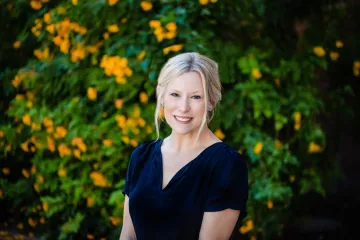
In this spotlight, Katherine Isaacson, Ph.D. student in Counseling Education, talks about finding her way to her project and how it has changed her approach to teaching. She presented her project to her department this summer. Learn more about her work at the UA TAR project archives.
What inspired you to do your TAR project on collective reflection and indigenous talking circles?
Counselor education trains students to become licensed counselors, and a major part of that training involves reflection. Throughout their program, students are asked to intentionally look at their experiences, assumptions, and behaviors with a focus on growth. Personally, I’ve always struggled with the limited choice of reflection methods in counselor training. Journaling and writing papers for reflection have always struck me as isolating. As a licensed counselor who knows there are other ways to develop self-reflection skills, I wanted to challenge dominant ways of acquiring knowledge. Shifting toward something collaborative, non-hierarchical, and focused on centering student voices is better aligned with counseling values. In Talking Circle practice, participants sit together in a circle, and a talking piece, an object such as a stone or a stick, designates the speaker. When the talking piece is passed, participants can speak as much or as little as they want, while others listen, because listening is as important as speaking.
My TAR project asked what happens to students’ reflection process when it takes place in a collective space informed by Indigenous Talking Circle practices, centering the co-creation of meaning and relationality.
Tell us a little bit about what kind of data you collected and what you found.
I chose pragmatic qualitative inquiry in order to obtain the depth that I wanted. Three counseling students who participated in the collective reflection activity volunteered for 30- to 40-minute semi-structured interviews. My analysis generated four themes: significance, safety, relational regulation, and cultural development. First, students found the activity to be meaningful and distinct because of the multidimensional prompts and the intentionality in addressing the Indigenous cultural origins. Second, clear expectations for turn-taking and choice in disclosure also helped them build safety that made sharing a possibility.
At the same time, students self-monitored, putting the group’s well-being first and holding back when their experiences differed too much from others’. Because their attention was focused on protecting the group, they didn’t turn inward to reflect on their own cultural positions, so this suggested to me that more intentional prompts could support students’ movement from appreciation toward cultural humility.
What did you learn about yourself as an educator through this process?
TAR was an incredible experience that has contributed immensely to my growth as an educator. I hadn’t conducted research in many years, and the course’s step-by-step structure made it a great reintroduction to research design. More than anything, I learned the value of praxis in teaching and that continuous reflection on my actions is my most powerful tool.
As I continue to develop my identity as an educator, I will keep gathering feedback and data from students so I can be intentional about my practice. I also learned that decolonial praxis especially resonates with me, and I will continue introducing students to different ways of knowing and being to challenge dominant systems.
How did you turn your project into a presentation for your department? Did anyone ask you any questions that surprised you?
Our department, Disability and Psychoeducational Studies, hosts an annual research symposium, and I proudly presented my TAR project there. I used a simple slideshow featuring Indigenous artwork throughout and invited attendees to join me in a circle for the presentation. My intention was to help attendees get a sense of what the students may have experienced and to show how something as simple as sitting closer together in a circle can completely change the experience.
Honestly, I don’t remember any questions that surprised me- I think I was running purely on adrenaline!
What advice would you have for graduate students who might be interested in doing a TAR project?
My advice is to focus on a learning problem that truly interests you, and not to worry if your research question takes time to develop. Build in ways to gather feedback from students, because that is where much of the learning happens. And know that no matter how “small” a TAR project may seem, it can still inform and impact your growth as an educator!
About Katherine

Katherine is a clinical therapist and a second-year doctoral student in the Counselor Education and Supervision program at the University of Arizona. Her research is starting to lean into the intersection of counselor identity development and decolonial praxis. Across research, clinical, and classroom practice, she is dedicated to co-creating spaces where students and clients feel seen, supported, and able to bring their full voices and stories to the forefront.